
info@new-leaf-pathways.com

Free Resources

Whether you just found out you need an evaluation, you’re supporting someone who does, or tonight is just a hard night — there’s something here you can use right now.

Need help right now?Call or text 988 for crisis support, 24/7Immediate danger: 911SAMHSA treatment referral: 1-800-662-4357

Eight free worksheets. Open one to print it, or download it and type in the boxes. No appointment or purchase needed.

Coping Skills

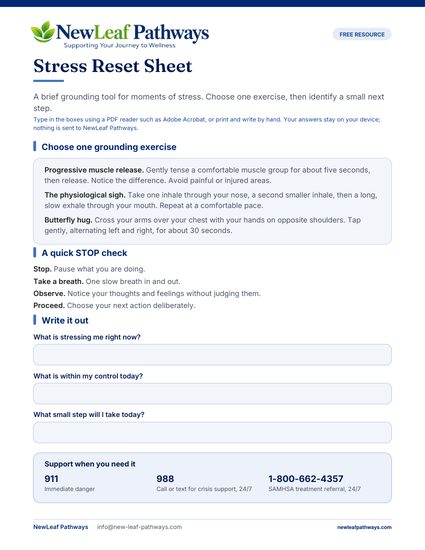
Stress Reset Sheet

Three grounding exercises, a STOP check, and space to choose one small next step.

Text version
FREE RESOURCE Stress Reset Sheet A brief grounding tool for moments of stress. Choose one exercise, then identify a small next step. Type in the boxes using a PDF reader such as Adobe Acrobat, or print and write by hand. Your answers stay on your device; nothing is sent to NewLeaf Pathways. Choose one grounding exercise Progressive muscle release. Gently tense a comfortable muscle group for about five seconds, then release. Notice the difference. Avoid painful or injured areas. The physiological sigh. Take one inhale through your nose, a second smaller inhale, then a long, slow exhale through your mouth. Repeat at a comfortable pace. Butterfly hug. Cross your arms over your chest with your hands on opposite shoulders. Tap gently, alternating left and right, for about 30 seconds. A quick STOP check Stop. Pause what you are doing. Take a breath. One slow breath in and out. Observe. Notice your thoughts and feelings without judging them. Proceed. Choose your next action deliberately. Write it out What is stressing me right now? What is within my control today? What small step will I take today? Support when you need it 911 988 1-800-662-4357 Immediate danger Call or text for crisis support, 24/7 SAMHSA treatment referral, 24/7 NewLeaf Pathways info@new-leaf-pathways.com newleafpathways.com
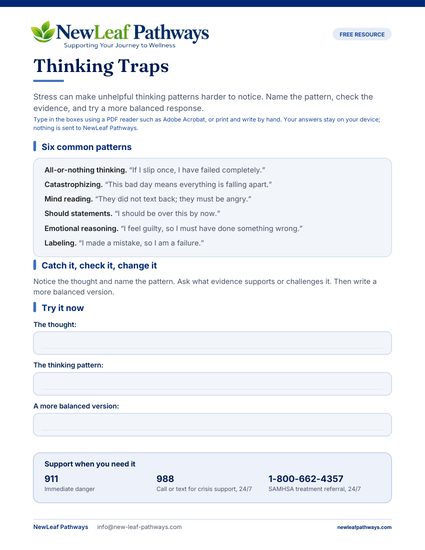
Thinking Traps Guide

Recognize six common thinking patterns and practice a more balanced response.

Text version
FREE RESOURCE Thinking Traps Stress can make unhelpful thinking patterns harder to notice. Name the pattern, check the evidence, and try a more balanced response. Type in the boxes using a PDF reader such as Adobe Acrobat, or print and write by hand. Your answers stay on your device; nothing is sent to NewLeaf Pathways. Six common patterns All-or-nothing thinking. “If I slip once, I have failed completely.” Catastrophizing. “This bad day means everything is falling apart.” Mind reading. “They did not text back; they must be angry.” Should statements. “I should be over this by now.” Emotional reasoning. “I feel guilty, so I must have done something wrong.” Labeling. “I made a mistake, so I am a failure.” Catch it, check it, change it Notice the thought and name the pattern. Ask what evidence supports or challenges it. Then write a more balanced version. Try it now The thought: The thinking pattern: A more balanced version: Support when you need it 911 988 1-800-662-4357 Immediate danger Call or text for crisis support, 24/7 SAMHSA treatment referral, 24/7 NewLeaf Pathways info@new-leaf-pathways.com newleafpathways.com
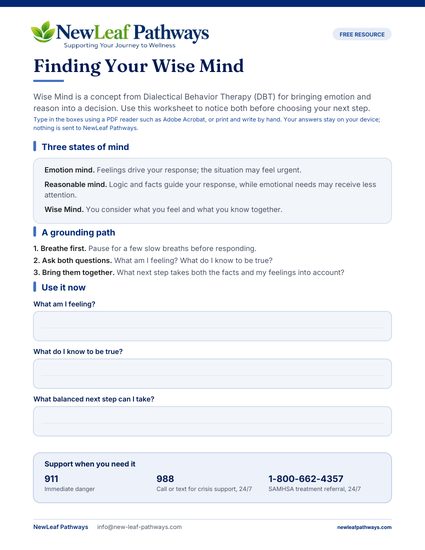
Finding Your Wise Mind

Consider feelings and facts together before choosing your next step.

Text version
FREE RESOURCE Finding Your Wise Mind Wise Mind is a concept from Dialectical Behavior Therapy (DBT) for bringing emotion and reason into a decision. Use this worksheet to notice both before choosing your next step. Type in the boxes using a PDF reader such as Adobe Acrobat, or print and write by hand. Your answers stay on your device; nothing is sent to NewLeaf Pathways. Three states of mind Emotion mind. Feelings drive your response; the situation may feel urgent. Reasonable mind. Logic and facts guide your response, while emotional needs may receive less attention. Wise Mind. You consider what you feel and what you know together. A grounding path 1. Breathe first. Pause for a few slow breaths before responding. 2. Ask both questions. What am I feeling? What do I know to be true? 3. Bring them together. What next step takes both the facts and my feelings into account? Use it now What am I feeling? What do I know to be true? What balanced next step can I take? Support when you need it 911 988 1-800-662-4357 Immediate danger Call or text for crisis support, 24/7 SAMHSA treatment referral, 24/7 NewLeaf Pathways info@new-leaf-pathways.com newleafpathways.com
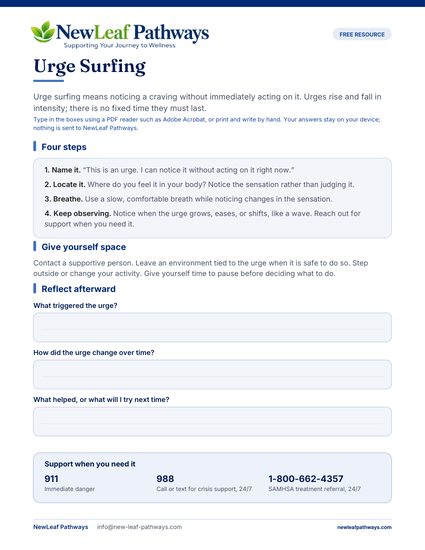
Urge Surfing Guide

Practice observing a craving without immediately acting on it, then reflect on what helped.

Text version
FREE RESOURCE Urge Surfing Urge surfing means noticing a craving without immediately acting on it. Urges rise and fall in intensity; there is no fixed time they must last. Type in the boxes using a PDF reader such as Adobe Acrobat, or print and write by hand. Your answers stay on your device; nothing is sent to NewLeaf Pathways. Four steps 1. Name it. “This is an urge. I can notice it without acting on it right now.” 2. Locate it. Where do you feel it in your body? Notice the sensation rather than judging it. 3. Breathe. Use a slow, comfortable breath while noticing changes in the sensation. 4. Keep observing. Notice when the urge grows, eases, or shifts, like a wave. Reach out for support when you need it. Give yourself space Contact a supportive person. Leave an environment tied to the urge when it is safe to do so. Step outside or change your activity. Give yourself time to pause before deciding what to do. Reflect afterward What triggered the urge? How did the urge change over time? What helped, or what will I try next time? Support when you need it 911 988 1-800-662-4357 Immediate danger Call or text for crisis support, 24/7 SAMHSA treatment referral, 24/7 NewLeaf Pathways info@new-leaf-pathways.com newleafpathways.com
Planning and Support

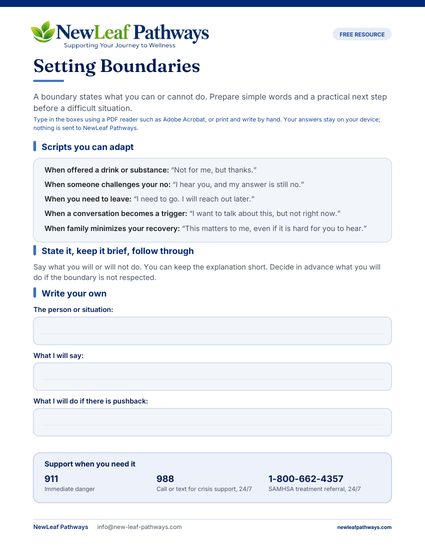
Setting Boundaries Scripts

Adapt simple boundary-setting language and plan how you will follow through.

Text version
FREE RESOURCE Setting Boundaries A boundary states what you can or cannot do. Prepare simple words and a practical next step before a difficult situation. Type in the boxes using a PDF reader such as Adobe Acrobat, or print and write by hand. Your answers stay on your device; nothing is sent to NewLeaf Pathways. Scripts you can adapt When offered a drink or substance: “Not for me, but thanks.” When someone challenges your no: “I hear you, and my answer is still no.” When you need to leave: “I need to go. I will reach out later.” When a conversation becomes a trigger: “I want to talk about this, but not right now.” When family minimizes your recovery: “This matters to me, even if it is hard for you to hear.” State it, keep it brief, follow through Say what you will or will not do. You can keep the explanation short. Decide in advance what you will do if the boundary is not respected. Write your own The person or situation: What I will say: What I will do if there is pushback: Support when you need it 911 988 1-800-662-4357 Immediate danger Call or text for crisis support, 24/7 SAMHSA treatment referral, 24/7 NewLeaf Pathways info@new-leaf-pathways.com newleafpathways.com
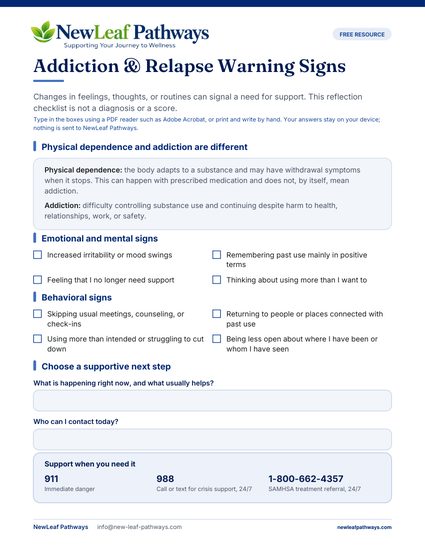
Warning Signs Checklist

Notice changes in thoughts, feelings, and routines, then identify a supportive next step. This is not a diagnostic test.

Text version
FREE RESOURCE Addiction & Relapse Warning Signs Changes in feelings, thoughts, or routines can signal a need for support. This reflection checklist is not a diagnosis or a score. Type in the boxes using a PDF reader such as Adobe Acrobat, or print and write by hand. Your answers stay on your device; nothing is sent to NewLeaf Pathways. Physical dependence and addiction are different Physical dependence: the body adapts to a substance and may have withdrawal symptoms when it stops. This can happen with prescribed medication and does not, by itself, mean addiction. Addiction: difficulty controlling substance use and continuing despite harm to health, relationships, work, or safety. Emotional and mental signs Increased irritability or mood swings Remembering past use mainly in positive terms Feeling that I no longer need support Thinking about using more than I want to Behavioral signs Skipping usual meetings, counseling, or Returning to people or places connected with check-ins past use Using more than intended or struggling to cut Being less open about where I have been or down whom I have seen Choose a supportive next step What is happening right now, and what usually helps? Who can I contact today? Support when you need it 911 988 1-800-662-4357 Immediate danger Call or text for crisis support, 24/7 SAMHSA treatment referral, 24/7 NewLeaf Pathways info@new-leaf-pathways.com newleafpathways.com
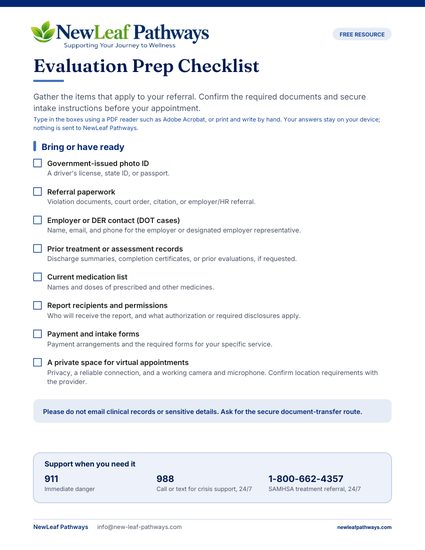
Evaluation Prep Checklist

Gather the documents that apply to your referral and confirm secure intake requirements.

Text version
FREE RESOURCE Evaluation Prep Checklist Gather the items that apply to your referral. Confirm the required documents and secure intake instructions before your appointment. Type in the boxes using a PDF reader such as Adobe Acrobat, or print and write by hand. Your answers stay on your device; nothing is sent to NewLeaf Pathways. Bring or have ready Government-issued photo ID A driver’s license, state ID, or passport. Referral paperwork Violation documents, court order, citation, or employer/HR referral. Employer or DER contact (DOT cases) Name, email, and phone for the employer or designated employer representative. Prior treatment or assessment records Discharge summaries, completion certificates, or prior evaluations, if requested. Current medication list Names and doses of prescribed and other medicines. Report recipients and permissions Who will receive the report, and what authorization or required disclosures apply. Payment and intake forms Payment arrangements and the required forms for your specific service. A private space for virtual appointments Privacy, a reliable connection, and a working camera and microphone. Confirm location requirements with the provider. Please do not email clinical records or sensitive details. Ask for the secure document-transfer route. Support when you need it 911 988 1-800-662-4357 Immediate danger Call or text for crisis support, 24/7 SAMHSA treatment referral, 24/7 NewLeaf Pathways info@new-leaf-pathways.com newleafpathways.com
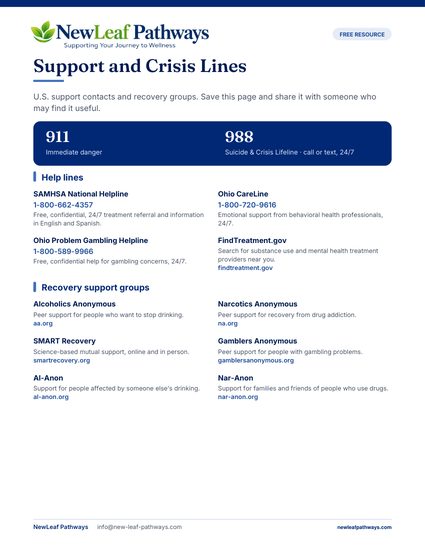
Support Lines

U.S. and Ohio crisis lines, treatment referral, and recovery support groups.

Text version
FREE RESOURCE Support and Crisis Lines U.S. support contacts and recovery groups. Save this page and share it with someone who may find it useful. 911 988 Immediate danger Suicide & Crisis Lifeline · call or text, 24/7 Help lines SAMHSA National Helpline Ohio CareLine 1-800-662-4357 1-800-720-9616 Free, confidential, 24/7 treatment referral and information Emotional support from behavioral health professionals, in English and Spanish. 24/7. Ohio Problem Gambling Helpline FindTreatment.gov 1-800-589-9966 Search for substance use and mental health treatment Free, confidential help for gambling concerns, 24/7. providers near you. findtreatment.gov Recovery support groups Alcoholics Anonymous Narcotics Anonymous Peer support for people who want to stop drinking. Peer support for recovery from drug addiction. aa.org na.org SMART Recovery Gamblers Anonymous Science-based mutual support, online and in person. Peer support for people with gambling problems. smartrecovery.org gamblersanonymous.org Al-Anon Nar-Anon Support for people affected by someone else’s drinking. Support for families and friends of people who use drugs. al-anon.org nar-anon.org NewLeaf Pathways info@new-leaf-pathways.com newleafpathways.com

Questions About These Resources?

These resources are a starting point, not a diagnosis. A quick call can point you in the right direction.

BEFORE YOU BOOK

Booking Policy

Please read the policy, then choose an appointment time and pay to confirm your booking.

This website does not store your acknowledgment. You will also be asked to acknowledge the policy on the booking form. No appointment is reserved by checking this box.